
Lighting a blacked-out auditorium with the audience’s own phones
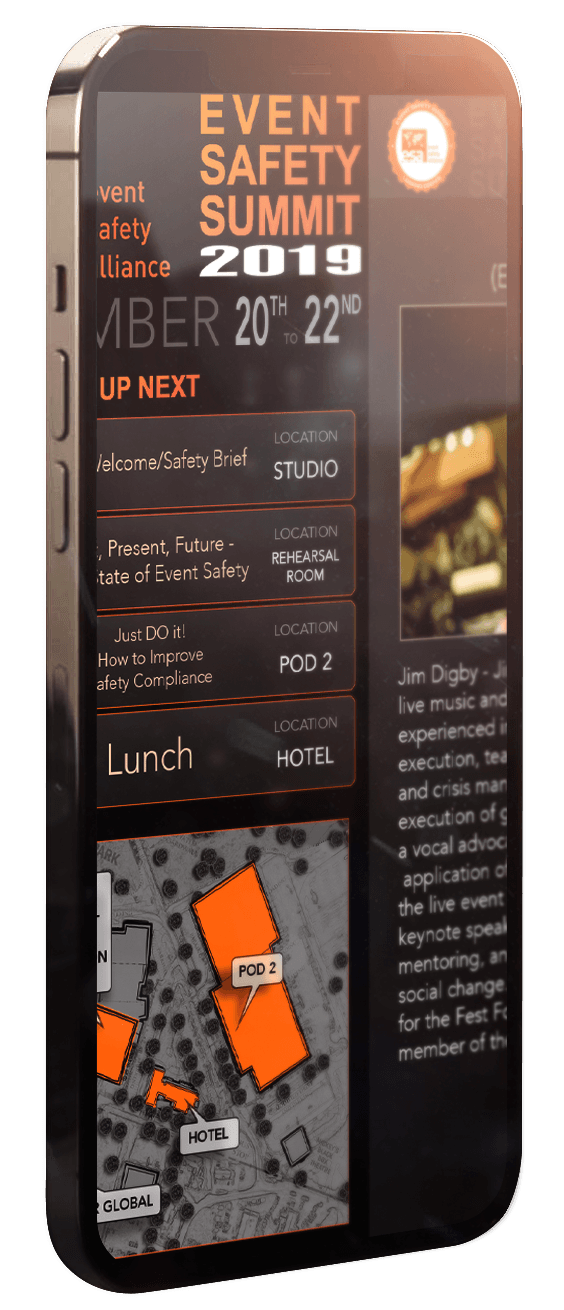
APPIX was the official app of the Event Safety Alliance’s Event Safety Summit. It carried the programme, took content changes live from the floor as the day moved, and during blackout drills turned the phones in the room into emergency lighting. None of it required WiFi or cellular.
- None
- Network required
- No WiFi, no cellular, no pairing
- Live
- Content updates
- Changed on site as the programme moved
- Lights on
- Blackout drill
- Auditorium lit from the audience’s phones
- Official app
- Recognition
- Event Safety Alliance summit
The challenge
A safety conference is the worst possible audience to demonstrate safety technology to, in the best possible way. These are the people who plan egress routes and run the drills for a living, and they will ask what happens when the assumption behind your system fails.
For event apps the assumption is always the network. Programme changes are pushed from a server, so a phone that cannot reach it shows yesterday's schedule. That is an inconvenience at a conference and a serious problem at an incident, because the moment you most need to tell a room something is the moment the network is least likely to be there.
A power cut takes the venue WiFi with it. A crowd saturates cellular on its own. Both conditions are ordinary rather than exotic, and an app that only works outside them is not a safety tool.
What we did
Everything ran over Bluetooth Low Energy broadcast rather than a connection. A control station on site drove a network of beacons; any phone in range with the app received what they advertised, without pairing, without a login, and without a route to the internet.
That made the content live in a way a conference app usually is not. We were in the building for the summit, and a change to the programme - a session moved, a room swapped, a speaker running long - became a change on every phone in range in seconds. Nobody had to reconnect to anything, and nobody had to be told to refresh.
The blackout drill used the same mechanism for something more direct. A single broadcast cue told every receiving app to switch on the device torch. The lights went out, and the auditorium lit itself from the seats.
It is worth being precise about why that is more than a party trick. Emergency lighting is a fixed installation sized for egress, and it fails in exactly the conditions it exists for. Meanwhile every person in the room is already carrying a light source, and in a blackout they are carrying it in the dark. The phones were not a replacement for emergency lighting - they were a second, independent one that arrives with the audience and does not share a failure mode with the building.
The outcome
APPIX was named official app of the Event Safety Summit.
The drill made the argument better than a slide could. A room of safety professionals watched a blackout light itself, and the question afterwards was not whether broadcast works but where else it applies.
The honest limits are worth stating, because this audience asked about them. It reaches phones that have the app and are in range of a beacon, so coverage is a function of how many people installed it and where the hardware sits. It is one-way: the phones receive, and nothing reports back. And it needs the control station powered, which on the night meant a battery.
What generalises is the design rule underneath. If a system has to work when the network is gone, it cannot be built on a connection - and the alternative is usually broadcast, which is not a lesser option but a different primitive.