
Read the plans once, and let the same number pay the crew
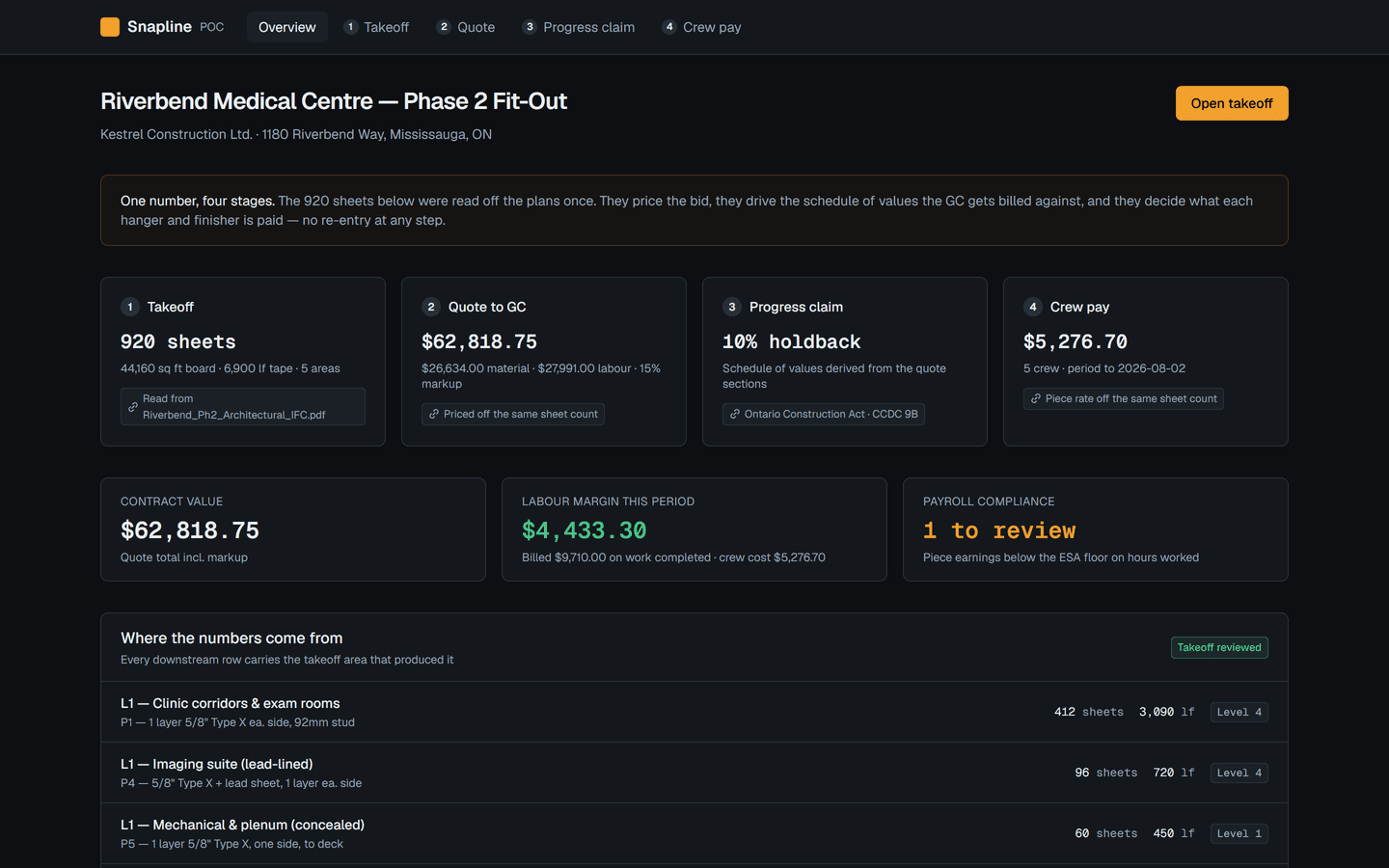
A drywall subcontractor reads the plans once. The same quantities price the bid, bill the general contractor, and pay the crew on Friday - with no re-entry at any step, because every downstream row points back at the takeoff that produced it.

Scan to open it on your phone.
- Zero
- Re-entry
- One takeoff drives all four stages
- 920 sheets
- Read from plans
- Once, by AI takeoff
- Every row
- Traceability
- Points back at the area that made it
- Proof of concept
- Status
- Built for customer interviews
The challenge
A drywall sub counts the same sheets three times, into three different tools.
Takeoff software stops at the bid. Construction project management software does the billing but knows nothing about drywall. Neither has any idea what a hanger gets paid on Friday. So the sheet count is keyed into a takeoff tool, keyed again into whatever produces the schedule of values, and keyed a third time into a spreadsheet that works out piece rates - then reconciled by hand when the three disagree.
They always disagree. And when they do, the number that loses is usually the one nobody is checking, which is the crew's.
What we did
One record, four stages, and a foreign key holding them together.
An AI takeoff reads the architectural PDF and produces the areas once - board area, tape length, sheet count, by level and by wall type. Nothing downstream re-enters those numbers. The quote lines, the schedule-of-values lines and the crew pay lines each carry a reference back to the takeoff area that produced them, so the chain is inspectable at every point: the interface can show you, for any dollar figure, which part of the plan it came from.
That single decision is the whole product. Everything else follows from it - the bid prices off the takeoff, the progress claim bills against a schedule of values derived from the quote sections, and the crew are paid piece rate off the same sheet count the general contractor is being billed for.
Two details matter more than they look. Progress claims carry holdback and follow the provincial construction act, because a claim that ignores holdback is not a claim anyone can send. And piece rate is checked against the employment standards floor on hours actually worked - a piece rate that pays below minimum wage is illegal no matter what the crew agreed to, and the system flags it rather than letting payroll discover it later.
There is a command that walks the whole chain and asserts it holds - quantities, totals and pay maths - because the claim being made is arithmetic, and arithmetic can be checked.
The outcome
The overview states the claim plainly: one number, four stages. The sheets read off the plans price the bid, drive the schedule of values the general contractor is billed against, and decide what each hanger and finisher is paid.
This is a proof of concept and says so on every screen. It exists to be put in front of eight or ten real drywall shops to find out whether the workflow it implies is one they would actually adopt - which is a different question from whether the software works, and the more important one.
We build things this way when the risk is in the idea rather than the implementation. A prototype that can be argued with beats a specification that can only be agreed to.